
1200x630_crossborder commerce

Why Are HS Codes So Important for Cross-Border Trade?

International shipping can be an excellent opportunity for brands to increase their sales. As cross-border e-commerce continues to grow worldwide, it becomes easier to reach customers worldwide. Your online store must be ready to meet the demand you have.

So, what about all the requirements and documents you need to import your products into other countries? Preparing your products for shipping across borders can seem daunting and overwhelming. If you already offer international shipping, you must have come across the term “HS code” and how important it is to be compliant to avoid penalties and delays in delivering your products to your customers. If you don’t know about it… don’t worry, after reading this blog, you will learn and understand it.    

HS codes are a fundamental part of international shipping. These codes classify your products and make it easier to fill out any needed international documents. It is important to be aware of the requirements to comply with customs and tax authorities to find a solution that can save you from problems that can cost you money and dissatisfied customers.   

For this reason, we will explain what HS codes are, how customs use them, their relevance to your Shopify store, and how we can help your business remove all the complexity of international growth. 

What is an HS Code?  

Harmonized System (HS) code is a standardized numerical method to classify goods being traded internationally. They are commonly used across the world by customs authorities to identify products when assessing duties and taxes, and to record imported products.  

Each HS code is composed of six digits. The first two digits are chapters, the following two digit headings, and the last two sub-headings. There are 21 sections, 99 chapters, 1,244 headings, and 5,224 sub-headings.   

Summary: key features of HS codes:  

  • Six-digit code to classify the goods 
  • Defined rules that classify the goods 
  • Act as a uniform standard for the classification of goods worldwide 
  • Covers 98% of goods in international trade and over 5000 commodities

How do Customs use HS Codes?  

Imagine everyday countries receive a large amount of goods from other parts of the world, and categories vary, as well as name, appearance and size of each product. So, it would take a long time for customs authorities to identify each product manually. Therefore, HS codes are used to identify imported goods more accurately and faster and charge the right amount of taxes and duties.   

It is vital for merchants to classify the imported goods and include this information correctly in the documents presented to customs. If not done correctly, you run the risk of customs opening your parcels and checking the content inside. If the HS codes declared do not match the product, your business might encounter the following issues:   

  • Considered non-compliant   
  • Extra charges to be paid   
  • Fines and charges as penalties   
  • Product rejections   
  • Delivery delays  
  • Unsatisfied customers  
  • Lower profit margins in case of paying a higher amount of tax or customer returns    

For these reasons and more, you need a partner and solution to help you with compliance. BorderGuru helps you avoid these risks by accurately mapping and automatically classifying all your products and assigning an HS code. We will be the importer of record and handle customs on your behalf. Once your products are shipped, we will ensure that they navigate customs safely and are seamlessly delivered to your end customers.   

 Why are HS Codes relevant for your Shopify Store, and how can BorderGuru help your business comply with customs?  

As already explained, HS codes are required to ship any product internationally. This can be complex for brands, as not only do products have to be accurately classified to be assigned an HS code, but also the information must be included in most international export documentation, like commercial invoices or certificates of origin.   

Failure to correctly assign HS codes or include all necessary information in customs documents can lead to delays, additional significant costs, and unsatisfied customers.   

It is important to consider all import requirements to offer international shipping in your Shopify store. Without HS codes and export documents, you will not be able to comply with customs, or deliver parcels to your international customers.   

BorderGuru can handle everything for you to correctly comply with all requirements, so that your business doesn’t encounter any issue when its parcels go through customs, and they can be easily dispatched and delivered to your customers around the world.    

We can also calculate and guarantee all landed costs at checkout to give you and your customers the best possible shipping experience.   


Click here to learn more about how BorderGuru can manage the entire process, from start to finish, to expand your business globally without complexities. 

ddp shipping

How Delivered Duty Paid (DDP) Can Benefit Your Online Business

As cross-border e-commerce sales continue to grow, US brands have great potential to reach customers worldwide. However, some aspects that brands must consider to handle international shipping in the best way to avoid headaches for the business and consumers. These include shipping costs, tax and Duty fees, and delivery times. If these aspects are not handled properly, the customer experience may suffer, and the brand may have consequences, such as higher shopping cart abandonment rates, higher shipping costs and lower conversion rates.   

Offering a DDP shipping solution addresses the top consumer concerns. However, for brands, it can be overwhelming, as every country has import taxes, duties fees, and requirements. Therefore, it is essential to have a solution that provides the best user experience, cost-effective operation and practicality for the business to expand internationally successfully.    

For this reason, we will explain what DDP is, how your company can benefit from it, and how we can help your business offer and handle DDP so your business can provide the best shipping experience for your customers.   

What is DDP?  

Delivered Duty Paid (DDP) shipping is when a merchant takes responsibility for all landed costs (taxes & duties) and charges them to the end customer without paying additional fees or dealing with customs delays.

This means that the merchant is responsible for the entire shipping process, from delivery of the package to payment of taxes and fees to the delivery to the end customer at the final destination. This helps build trust and improve the customer experience, as they have paid for everything up front; there will be no surprise fees when it arrives at the final destination.    

What is the difference between DDP and DDU? 

DDU is when the merchant is responsible for the entire shipping process, from sending to ensuring that the goods arrive safely at a destination. However, once the package is in the final country destination, the buyer is responsible for paying all the necessary import fees.   

The difference between DDP and DDU is that in DDU, the customer may have to pay import taxes without knowing the exact amount until the package arrives. As fees often come as a surprise, it creates a poor customer experience and can lead customers not to accept the goods, financially impacting the merchant.   

What are the benefits of offering DDP?  

The benefits of offering DDP are the following:  

  • Be transparent with taxes and duties fees  
  • Custom clear orders 
  • Avoid delivery delays 
  • Avoid extra costs 
  • Build trust  
  • Enhance customer service  
  • Lower cart abandonment  
  • Increase website conversion rates 

How can BorderGuru help your business handle and offer DDP on your Shopify store?  

Offering a DDP solution benefits both the brand and the end customer. Brands need to research tax and duty fees and import laws per country and calculate each product that will sell cross-border. If done on your own, this can become very overwhelming and might discourage you as a brand top opening your cross-border channel.  

With BorderGuru, you have a strategic partner that can help your Shopify store offer DDP and handle all import requirements for each country. Our solution takes everything from product mapping to tax filling. You don’t have to worry about import requirements, as we’ll have everything ready for you to ship your products as if it were local shipping.   

Our cross-border solution is a free plug-and-play app that can is integrated into your Shopify store within 10 minutes. It automatically and accurately calculates taxes and duties at checkout and offers your customers competitive shipping rates.   


BorderGuru is, as can be seen, a one-shop-stop solution for international shipping. It allows you to reach your customers regardless of location, as you can choose up to 200 countries to ship to.   

Our solution helps your brand to provide the best possible customer shop experience to increase trust, loyalty and sales.   

Contact us to learn more about how your brand can expand quickly internationally!    

Germany-partner

Germany – The Biggest Online Market in Europe

Country Report – GERMANY

Population & language 

Germany’s population is 84.3 million. It is the most populated nation in the EU. The median age is 47.8, and the official language is German. The country is the biggest economy in the European Union, and the currency is the Euro.  

Economy  

The German economy is the fourth-largest in the world in terms of PPP and Europe’s largest economy. Its GDP accounted for one quarter (24.2%) of the European Union’s GDP in 2020. Its current GDP per capita is $50,900 and purchasing power parity (PPP) is $4. 23 trillion.   

Trading Partners 

Germany is the United States` largest European trading partner and the sixth-largest market for US exports. As for imports to Germany, the US was third place in 2021 after China and the Netherlands, accounting for goods worth €72.1 billion. Imports from the US rose by 13.6%. In December 2021, the surplus was €6.8 billion. 

Digital overview 

The most common domain used in Germany is .de. The total internet users are 78.81 million, accounting for 89.81% of the population.  

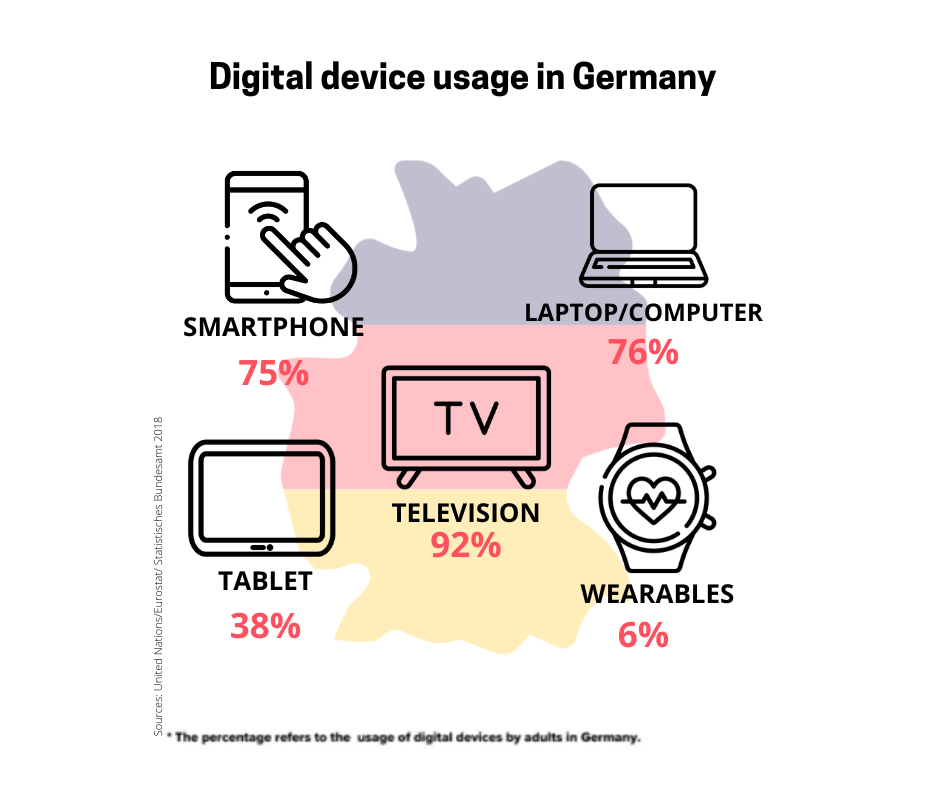
The most used device is a smartphone; 81% of Germans owned a smartphone. An interesting fact is that mobile no longer means on the go. 69% of all advertising is displayed via Wi-Fi, and only 23% via a cellular network. This report shows that Germans prefer to look at their phones in the commodity of their homes rather than using a tablet or computer to shop. 


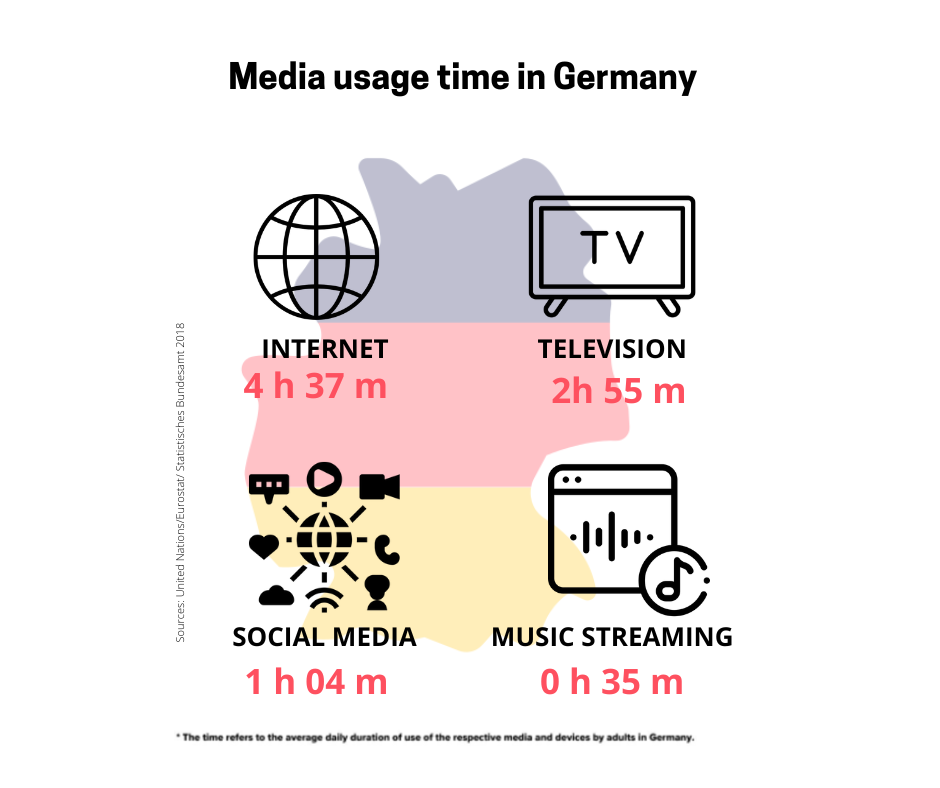
In terms of media usage time, people in Germany spend the most time on the internet than on any other medium.  

Common Payment methods  

The most common payment methods used for shopping online in Germany are PayPal, credit card, direct debit, e-wallet, and instant transfer. Having these payment options in your online store ensures a cart abandonment rate of 3%. It is important to consider these options because Germans trust them and are loyal to what works for them, which means that if you don’t offer them, the chances of leaving uncompleted transactions will be higher.  


E-commerce Outlook 

E-commerce has been on the rise worldwide, and Germany is no different. In 2020, online sales grew 14.6% compared to 2019, about 83.3 billion euros. The most significant increase was in 2021, which grew 19% over last year, worth 99.1 billion euros. If we account for digital services, the total worth of e-commerce reached 107.1 billion euros. 

In Germany, e-commerce has become the “New Normal,” It was strongly noticeable during the pandemic. Now, post-pandemic, it is still going and getting stronger as it shows that its benefits, a wider variety of products, and better service are what consumers need and want. Currently, the thinking of trading without e-commerce is unimaginable for both consumers and retailers.  

According to a study by RetailX, 85% of Germans shopped online in 2020. Consumers in this country are keener on shopping online rather than offline. The most popular product categories are apparel, consumer media, and electronics. 

As can be seen, there is a great opportunity for US online stores to sell to Germany as e-commerce continues to rise. Germany has an excellent trade partnership with the US, and there is a demand for US products.    

Fashion E-commerce industry 

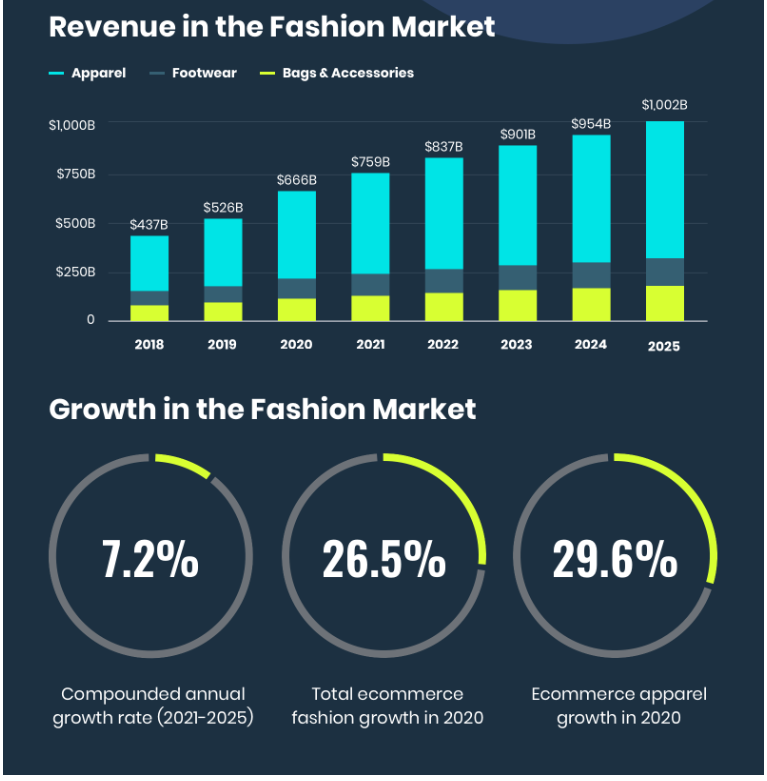
Fashion is a profitable industry in e-commerce with steady growth. Global sales in 2021 amounted to 759 billion US dollars and are expected to grow by 78 billion US dollars in 2022. As shown in the graph below, this segment continues to rise. The most popular sub-categories are apparel, footwear, and accessories.   


Source: Statista, commonthreadco.com

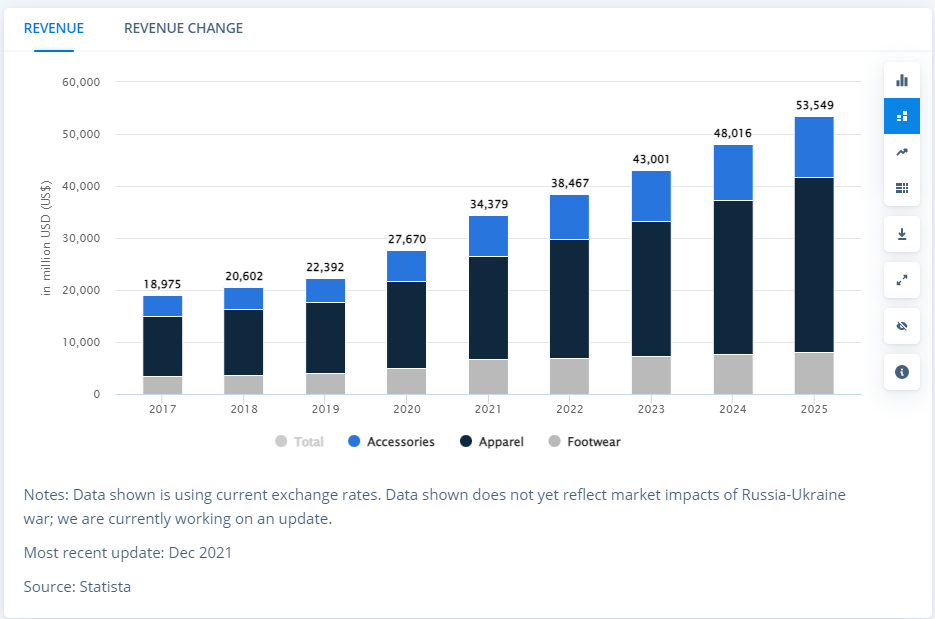
 The fashion segment is no different in Germany; it is one of the most popular segments in e-commerce. Revenue is expected to reach 38,467 million US dollars in 2022, with an annual growth rate of 11.66% from 2022 to 2025. User penetration will be 58.4% in 2022 and is expected to reach 67.9% by 2025. In 2021, the fashion segment accounted for 24% of the German e-commerce market, with a turnover of $26 billion. In 2021, the largest sub-categories were apparel, which accounts for 66% of sales. Then is footwear with 22%, and the remaining 12% is bags and accessories.   


Concerning imported apparel, Germany was the number one import market in the EU in 2020, along with France, Spain, Italy, the Netherlands, and Poland, with a total import value of 30.2 billion euros, of which 14.3 billion euros came from other EU countries and 15.9 billion euros from non-EU countries.   

The information presented here suggests that US brands have room and an excellent opportunity to sell their products online and have a piece of the pie.   

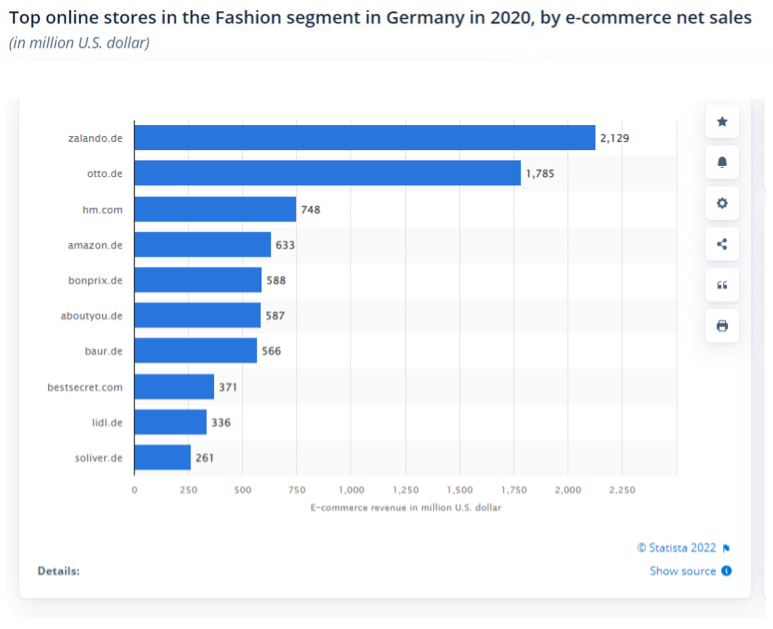
The largest Online Fashion Marketplaces  

The top marketplaces that offer US brands the opportunity to succeed in the German market are Zalando, Otto, Amazon, Bonprix, and AboutYou. It is worth looking into these marketplaces to see which one or which ones are suitable for your product in terms of the target market, traffic volume, and competition.   

Otto, Zalando and About You are the most suitable for US fashion brands to expand to Germany. The three offer US brands a great opportunity to expand into this country successfully. Once companies have acquired brand awareness and sustainable sales, the chances of success in other marketplaces are higher.   


At BorderGuru, we are part of the Otto Group and offer our Marketplace Partners solution. This solution allows US fashion brands the opportunity to expand into Germany and 26 other countries in Europe by participating in marketplaces such as Otto, Zalando, About You, and many more. This solution offers content localization, tax and legal compliance, logistics and customer service, and much more to facilitate the international expansion process.    

Learn how your brand can benefit from our solution by Booking a Demo and start achieving your international goals.   

cross-boder_e-commerce_

Top 10 Tips to Successfully Sell through Cross-border

As mentioned in our blog “Cross-Border eCommerce – The key to international growth,” e-commerce has been growing continuously. Sales have increased by US$1.57 trillion from 2019 to 2021, and this positive trend is expected to continue in the following years.  

As the lines between geographic borders in e-commerce get blurred, it gets easier for customers to purchase products from across the world, increasing the possibilities for US brands to broaden their international footprint.   

Considering the positive growth trend that cross-border e-Commerce has, we created a list of Top 10 tips to sell cross-border successfully.  


Does market research need to 'loosen up'?

1. Market research 

Before deciding on selling internationally, it is essential to research your potential customers to provide the best possible experience with your brand, products and website.   

These are three things to consider:   

    • Products: Research and look into the products your potential clients are most interested in, and also check if you need to make any changes to appeal more to their taste and cultural customs.   
    • Culture: Research the country your potential clients are from regarding their culture to avoid misunderstandings regarding your product or brand name, colors used, and communication style.   
    • Language: Although many international customers are bilingual and fluent in English, localizing your shop in terms of language, pricing, etc., can significantly benefit your business and differentiate you from your competitors. It also helps offer localized customer service, when possible, for a better customer experience.  


Is My Content Strategy Really Creating Brand Awareness? - Digital marketing agencies view

2. Brand awareness & trust  

Building brand awareness and trust is the key for your potential international customers to get to know your brand and your products.   

Here are some actions you can take to build awareness and trust:  

    • Create organic content using SEO and posting on social media  
    • Post reviews and testimonials  
    • Create videos of your product: how to use it, tips, features, and how your customers use it 
    • Paid ads on Google and social media to specifically target your intended market


The Competitive Pricing Strategy Guide (Covers B2B and B2C Businesses)

3. Pricing 

It is crucial to search the price of similar products from your competitors, from the country or countries to which you want to sell your products, and also to be aware of the additional costs that need to be added to the final price. This way, you can ensure that it is profitable to sell in the intended country/countries and if your prices are competitive.  


4 Lawyer Payment Methods Your Clients Want | Clio

4. Payment options  

Offering only the forms of payment popular in your local market is not enough to appeal to your international visitors. Our advice is to research the most commonly used payment methods by your target visitors or in the countries you are selling to. For example, in Europe, paying with Apple Pay, Google Wallet, PayPal, or bank transfer is very common. It is, therefore, a matter of finding out what your visitors use for online payments and offering them to increase your chances of succeeding.  


Currency Vectors & Illustrations for Free Download | Freepik

5. Multi-currency account 

A multi-currency solution and offering the option to pay in local currency on your website can save you headaches and provide a better user experience. Being transparent with your customers regarding prices could help your business in the long run; customers appreciate localization even if exchange rates are not in your hands.   


Best Premium Packing and moving services Illustration download in PNG & Vector format

6. Packaging  

Another aspect to consider is the type of packaging that you will use to avoid higher shipping costs and be more cost-efficient and sustainable. For example, you can recycle old boxes, paper bags, or paper sheets as a protective material for packages and use mailer envelopes or poly bags for small non-fragile items like clothing.  


Hermes delivery staff filmed throwing parcels against wall | The Independent

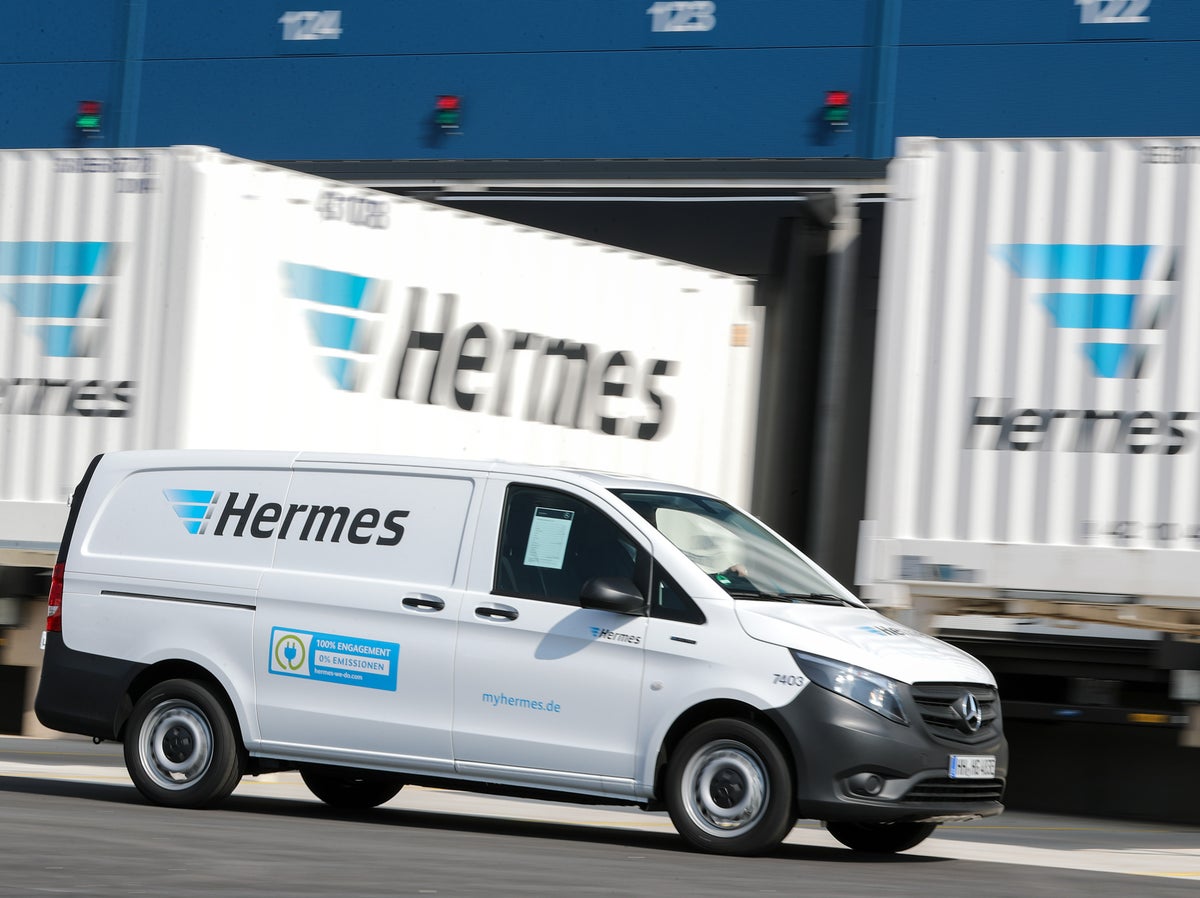
7. Shipping  

Shipping costs and delivery times are crucial for the success of your online business. Finding a shipping service suitable for your company that can offer you competitive prices and excellent quality service can be your competitive advantage.  

Also, displaying clear and concise information will help you be transparent with your customers, build trust and avoid unsatisfied customers, misunderstandings about shipping fees and delivery times, and not miss repurchases.


Video - Hermes Parcels fleet rebrand delivered on time | Aura

8. Returns  

Regarding returns, it is important to learn and understand the return rate and legislation of the country or countries your business is selling to. Make sure to have a transparent process and policies to handle returns and communicate them clearly to customers.  


Shipping Insurance – ZeroWasteStore.com

9. Insurance 

Insurance is an aspect that is not necessarily needed. It depends on the value of the products you sell. It is crucial to consider evaluating if shipping insurance is necessary based on the product’s value and the loss/damage rate your business has experienced. If the rate of loss/damage is too low and the product’s value is not significantly high, then it is not worth spending on insurance. 

Some cross-border solutions like BorderGuru have less than a 1% loss/damage rate, making it possible for businesses to add that percentage to their loss/damage concept in their budget and save by not paying extra fees on insurance. 


Tax deduction Vectors & Illustrations for Free Download | Freepik

10. Taxes & duties  

Tax laws vary among countries. You should be aware of them, but trying to manage international taxation on your own is not recommended. Cross-border solutions such as BorderGuru can file taxes, making it easy for your business. It also provides your customers with accurate information about taxes and duties to be paid at checkout and customs-cleared orders, so they do not have to worry about additional fees at the delivery time. This will give your business and customers a better shipping experience.   


Selling international comes with some hurdles, but you don’t have to do it alone. BorderGuru, as a cross-border solution, can facilitate international shipping for your business and your customers.   

Our solution offers competitive shipping costs and calculates taxes, duties, delivery times, and guaranteed customs-cleared orders at checkout.

Contact us now and start growing your international reach!   

Sell to canada

Canada: Cross-Border Selling Opportunity for US Brands

Canada is widely known as a significant trade partner for the United States. Canada’s imports were more prominent than exports in 2020, $510.29 billion compared to $477.31 billion. The US represented 57% of total imports, while China was 11% and Mexico was 5%.   


As for cross-border online sales, as seen in the graph below, the US has the largest share, as consumers buy most products from this country, second China and thirdly the UK.   

As can be seen, US brands have a big opportunity to enter and penetrate the Canadian market.   

For this reason, we are discussing further market & economy overview, Digital overview, e-commerce outlook, and how BorderGuru can help your brand expand into a country full of opportunities to increase your international sales.    


Population & Economy overview  

Canada has a population of 38.23 million. The most populous provinces are Ontario, Quebec, and British Columbia. The median age is 41.8 years, and the largest age group in percentage is people between 25 and 54 years (39.81%), as can be seen in the image below: 

The official languages are English and French, and the currency is the Canadian dollar. The exchange rate is approx. 1 USD = 1.28 CAD. In terms of Economy, Canada is among the top ten largest economies in the world. In 2020, it was 9th place with a GDP per capita of $43,295 and a Purchasing Power Parity (PPP) of $1.74 trillion.   

International trade is an essential component of Canada’s Economy. Exports and imports account for about one-third of GDP. 


Digital Overview 


Canada is considered one of the largest online markets in America, with 36.39 million users in January 2022. It also has a high percentage of Internet users, as seen in the image below, meaning that almost 100% of the population has access to the Internet. It is also worth noting that a high percentage of the population uses a mobile device to access the Internet. 

Regarding social media, a large percentage of the population is a member of a social media platform (87.1%). In January 2022, the number of users was 33.30 million. The most popular social media platforms are YouTube (33.30m), Facebook (20.90m), LinkedIn (19m) and Instagram (17.40m). It is important to be aware of the social media users for marketing your products, where you can get the most traction and have higher opportunities to increase sales. 

According to Statista, in 2021, the most popular online activities conducted by Internet users in Canada were email 85%, online banking 67%, social media 58%, access news headlines 53% and online shopping 48%. Shopping is one of the five most important activities as e-commerce sales grew considerably; As we will see next, “E-commerce Outlook.” 


E-commerce outlook 


Global e-commerce sales have grown significantly since 2019 and even more during the COVID-19 pandemic. In Canada, it happened the same way; and during the pandemic, online sales increased as online shopping became the new normal for all generations. Now that restrictions have been lifted and shops are open, purchasing behavior has changed slightly for older generations. Still, for Millennials and Generation Z, online shopping will continue to increase.  

In 2021, Canada was the tenth largest e-commerce market with a revenue of $35 billion, ahead of Australia and Indonesia. In the same year, there were 27 million e-commerce users in Canada, representing 72.5% of the total population, and is expected to grow by 77.6% in 2025.   

Cross-border purchases are also still popular with Canadian consumers, as they believe there is a better selection of products and lower prices when buying from other countries. As it has already been shown, the US is a significant player in the Canadian market, and consumers expect to continue to do most of their online shopping from US brands.   

As for the product categories, the top 5 are clothing (50%), shoes (32%), entertainment (30%), consumer electronics (30%) and cosmetics & body care (26%). 


This graph shows that US brands in the sectors of fashion and lifestyles have an excellent opportunity to continue to capitalize and that new players can start to capitalize on this ever-growing e-commerce market.   

For US brands to succeed in Canada as a cross-border e-commerce merchant, it is crucial to consider consumers’ expectations, needs and wishes to offer them the best possible online experience and to be able to attract and convert them into loyal customers. 


Top 5 aspects to consider that strongly influence Canadian consumers’ online purchasing decisions 


1- Word of mouth, social media influencers, video content, and online customer reviews strongly influence Gen Z and Millennial consumers’ purchasing decisions.   

2- Make the returns policy friendly: 63% of shoppers have abandoned their carts because of an unclear or complicated returns policy.  

3- Prioritize delivery: 58% of consumers are influenced by delivery speed, and 46% are motivated to buy from brands that deliver on the expected date.   

4- Customer experience: 46% of consumers are influenced by loyalty or reward programs. It is also essential to consider promotional content.   

5- Consider the environment: 37% of consumers prefer brands that are aware of their carbon footprint and are committed to reducing it.   


With BorderGuru, you can expand your brand to Canada and other 200 countries without any hurdles and offer your customers the best online shopping and shipping experience. We calculate all taxes and duties in real-time and handle them for you. We provide your customers with custom-clear orders and competitive shipping prices. They will never have to deal with additional surprise fees at the delivery time. 

Contact us now and expand your global business without the challenges of international compliance! 


London, England – February 23, 2019: Customs, VAT Exports, Commercial Exports and Border Control at Terminal 5 at London Heathrow Airport, England, United Kingdom, Europe

IOSS and UK VAT Compliance for US Shopify Stores

As a Shopify store owner in the US, you are undoubtedly interested in selling your goods to the EU and UK markets. Since e-commerce sales in these markets have grown massively and will continue for years to come, the opportunity for US brands to make a profit is significant. This is also why your company should be informed and aware of IOSS and UK VAT and have a solution to handle compliance for your company correctly.   

What are the current European Union import regulations?

Current EU import regulations are different from those before July 2021. Now US sellers must collect VAT on all goods they sell to the EU customers; the difference was that before, goods valued at 22 euros or less were Import VAT exempted. Therefore, you now need to determine the VAT rates of specific goods for all the EU countries you deliver to.

Additionally, you must declare in-customs all goods entering the EU regardless of their value. This means that when you sell to a customer located in any of the 27 EU members, the parcel must come with a customs declaration form.

What is IOSS and how can BorderGuru help me with cross-border selling to the EU?

The Import One-Stop-Shop (IOSS) is an electronic portal that eases the process of complying with VAT e-commerce obligations on imported goods valued < 150 EUR. With IOSS, you do not have to register in each EU country where you sell your products. Instead, you only pay the country of registration and then the authorities are in charge of distributing the taxes to the local tax authorities in which the customer is located; this makes the collection, declaration and payment of the VAT for US sellers easier.    

Even though IOSS intends to make this process easier for non-EU brands, they still need to deal with VAT registration, finding a local fiscal representative, collecting taxes from customers, recording and filing, etc.  

With BorderGuru, compliance with EU tax authorities becomes a simple task for your business. BorderGuru imports into the EU, which helps your company eliminate the complexity of selling and sending to the EU. Here are some benefits of using BorderGuru: 

  • We represent you before EU tax authorities  
  • We provide you with an IOSS number  
  • We provide HS codes   
  • We calculate taxes and duties to be paid at the checkout by your customers   
  • We file your business` taxes on your behalf and keep a record  
  • We offer custom cleared orders 
  • We guarantee the accuracy of our calculation at checkout

What about UK VAT and how can BorderGuru support you?  

Since the UK separated from the EU, it has import tax regulations. HM Revenue & Customs (HMRC) is responsible for tax collection and regulation. If the products you sell to UK customers cost more than135 GBP, you must register your business and pay taxes to HMRC.   

BorderGuru helps you make this process easy for your business, so you do not have to worry about dealing with it on your own and instead focus on selling and connecting with more UK customers.   

We provide you with the same benefits as with the EU, such as UK VAT number, we calculate, file and record taxes and duties, and provide your customers with custom cleared orders. We guarantee the accuracy of our calculation at checkout.   

BorderGuru offers a complete cross-border solution that helps you with IOSS and UK VAT compliance and allows you to ship to 200 countries at a competitive price, calculating tax and duties at checkout and providing customs cleared orders. Additionally, it is effortless to integrate into your Shopify online store.   

If you want to bring your cross-border sales to the next level, get in touch with us! 

Boost-Your-Conversions

Top 10 ways to increase your Shopify Store conversions

The goal of any online shop owner is to generate sales and delight customers through that channel, whether they are new customers or existing ones. Website traffic and conversion come into play here, as both go hand in hand. Without traffic to their website, there is no other way to get leads to turn into actual customers.  

Traffic can increase your business’s chances of growing, expanding your product line, selling to other countries, and developing more services or products. On the other hand, keep in mind that traffic itself does not create sales, and this is when conversion plays an important role.

Before we go deeper into how to increase your traffic conversion, we will start by defining web traffic and conversion. 

What is Website Traffic? The simple definition is the number of visitors a website gets. Years ago, website traffic alone was a crucial metric. Now it is known that this is only part of the equation, as the first step is getting visitors, but they cannot count as customers/sales until conversion happens.   

What is Conversion? Conversion is when website visitors complete a desired action, whether purchasing a product, signing up for a service, downloading content like white papers, or completing a web form.   

How do you calculate your website conversion? This process consists in knowing if your online shop is giving results, it is essential to measure your website conversion. 

The following is the formula to calculate your website’s conversion rate: 

Conversions - nexoya

Conversion Rate Optimization (CRO): 8 Ways To Get Started (hubspot.com)

Suppose you have different calls to action within your website, such as downloading content, subscribing to your email list, and purchasing a product. In that case, you can calculate the conversion rate of each, but make sure you only count the number of visitors on the websites where the offer is listed. 

 It is important to implement strategies that can lead to sustainable growth to convert your new and existing traffic and leads. We present you with the top 10 ways to increase your store conversions. 

Top 10 ways to increase your website’s conversion  

1. Tell your customers why they should buy from you 

This information is essential to differentiate your brand from your competitors. Nowadays, consumers care not only about the product but also about the purpose and background story of the brand. Identify value elements for your customers, and excel on at least one of these elements to connect with your target market. Once it has been identified, focus on it wherever you can, from the homepage to the About page, etc. 

2. Simplify the user experience 

In order to engage your visitors and have a higher chance of converting them into your customers, it is vital to have a simple homepage to understand and navigate and with a clear call to action. For example, you can display your best sellers, discounts, or new collections. This way, you can attract your audience and drive them to make a purchase. 

It is also essential to have a search feature: This is helpful for visitors who know what they are looking for and tend to use this feature. This may prevent customers from bouncing out of your website because it is difficult to find what they want.   

3. Test your page loading speed  

The performance of your website is a make-it-or-break deal for your business. If your website takes too long to load, your visitors will bounce out immediately, and you will miss out on them finding out about your brand and products. There is also a high possibility that they will leave with a wrong impression, and it could be harder to get them to visit again.  

Loading speed is important and should take an average of three seconds to enter your website. Make sure you test the loading speed of your website on every device, as it should perform the same or about the same; otherwise, you may miss visitors who use a mobile phone or tablet. According to Google, 53% of mobile visitors leave a website if it takes more than three seconds to load.   

4. Optimize your products page 

When consumers browse for a product, many website options come out, so this is when you have to set yourself apart. The best way to do it is by making sure your product pages have the following:   

  • Craft concisely and short descriptions of your products, highlighting the primary information   
  • Use quality images, preferably professional 3D   
  • Educational videos (How to use your product)   
  • Showcase product reviews   

 5- Implement trust boosters  

Nowadays, with many brands and product options on the Internet, it can be challenging to know which site to trust unless you are a well-known brand like H&M, Nike, etc. The best way to build trust among your visitors is to show that your existing customers are loyal and what they think about your brand and your products.   

Social proof can give a big tust boost. You can display product reviews on your website in writing, images, or videos, but make sure they are accurate and that you have permission to publish them publicly. You can do this also on social media. Our recommendation would be to use the stories or live features so that you can engage better with your audience and build a stronger trust bond.   

6- Display clear information regarding price, shipping, extra fees, and out-of-stock products 

According to Baymard Institution, one of the top reasons for cart abandonment is that extra costs are too high. To reduce cart abandonment, it is important not to mislead your customers and be upfront regarding all the fees incurred, including shipping, taxes & duties, delivery information and out-of-stock products. Having clear information on your site and checkout page will also help you build trust that can be converted into sales.   

 Suppose your business encounters high shipping costs and unclear information on tax and duties. In that case, we recommend you look for a cross-border solution that can provide you and your customers with a smooth shipping experience. BorderGuru is a suitable option for you, as we offer competitive shipping costs and calculate taxes & duties fees, displaying all fee information clearly at checkout. This helps to be transparent and expedite delivery, as all items are customs cleared.     

7- Simplify your checkout process   

The checkout feature is the last step customers go through to make a purchase, so it must be as flawless and easiest as possible to avoid unfinished transactions. It is essential to provide different checkout options, such as Member Checkout, Guest Checkout and PayPal Checkout. Simplifying the tour checkout process will help reduce the chances of your customers abandoning their carts at the last moment.   

Another way to maximize the checkout process is to include two or more checkouts on your website, for example, at the top and bottom. As they scroll, the checkout option moves along, and they can easily click on it.   

Remember to consider your customers’ experience and put yourself in their shoes to understand their wants and needs, to check whether improvements need to be made to improve their experience and increase your sales. 

8- Offer free exciting content for your audience  

Having a designated space within your website to offer content related to what you sell, exciting and relevant to your audience, can be an excellent opportunity to drive traffic to your website and convert visitors into actual customers. Don’t forget to add calls-to-action to your content so that it can actually help increase conversion rates.   

It is also important to constantly update your blog, as it helps keep customers coming back for more and building loyalty.   

9- Display coupon codes, promotions and real-time purchases  

As soon as users enter your homepage, you have a few seconds to build excitement and drive them to your products. So, you have to be mindful and develop a strategy to attract them immediately and create the urgency to buy your products. This can be done by displaying discounts, promotions, or pop-ups that offer a coupon for their first purchase in exchange for their email. To create urgency and trust, you can also display real-time purchases on your homepage. 

10- Send personalized emails and notifications  

Personalization can be an effective strategy to increase customer retention and loyalty and boost your conversion rates. All you need is information regarding your customers and visitors, such as pages visited, products bought in the past, where are they from, etc. 

Once you have the information, you can work on personalized content, for example sending discounts on the products they have looked into or bought before and emails with relevant and helpful information about the products they are interested in or topics related to these products. For example, if a customer is interested in summer dresses, you could send promotional emails or information about summer fashion. Remember to maximize the use of the information you have about your customers and visitors,to turn it into a positive result in your business.   

 All the recommendations above have one thing in common; they all focus on the user. This means that before you decide to change or add something to your website, you should research your target market and current visitors to improve and grow your business. 

BorderGuru offers you a hassle-free international shipping service and a pleasant experience for your customers at checkout. Contact Us Now and start converting your traffic into customers.  


ecommerce-shipping-costs

How to Lower Your Shopify Store Shipping Costs for International Growth

Shipping costs have become a key factor for e-commerce businesses. In 2018 alone, US companies spent $1.49 trillion on shipping, while mid-size companies overspend around 13% on shipping annually. This article shows how important it is for online shops, especially small-medium size companies (SMEs), to research and create a shipping strategy that suits their business needs.    

For SMEs, international shipping is sometimes a big challenge rather than an opportunity to grow their business. Before creating or changing any strategy to offer international shipping, companies should research and look into different shipping options to find a profitable way to grow their business internationally and deal with the hurdles of cross-border shipping.    

Here are five suggestions for businesses to save on shipping costs:  


Air, cargo, plane, shipping icon - Download on Iconfinder
Shipping rates

Shipping rates can be a make-or-break factor for online stores, especially SMEs; it is essential to look into different carriers’ options and cross-border solutions to find the most suitable for their business and customers.  

 Although the most common carriers like USPS, USP, and FedEx offer rates for small businesses, they may not be the best deal. Using third-party logistics brokers may offer better rates for smaller volumes could be a better option.  

BorderGuru, on the other hand, is part of Hermes, a global logistics champion base in Germany and offers competitive rates for cross-border shipping for online stores. BorderGuru is not a broker; it is a one-stop-shop solution focused on online stores that consolidate thousands of online orders from different stores and ship them to 200 countries worldwide. Getting to a specific volume to get a good deal is not a problem with BorderGuru.


Box, package, packaging, packing icon - Download on Iconfinder

Packing supplies  

Packing supplies are also essential to consider, and if not thoroughly planned, businesses can waste a lot of money on them. Nowadays, there are many hacks to save on this; here are some tips:    

  • Get an affordable shredder machine and recycle old boxes, paper bags, or paper sheets as a protective material for packages.  
  • Get packing supplies at wholesale (bubble-wrapped paper, mailers, and dunnage).  
  • Look for free packaging or discounts that some carriers offer. 
  •  Weight and dimensions of the package  

Weight and dimensions play an important role in the shipping cost. Being wise in choosing the right packaging size for the product can make a significant difference. For example, using mailer envelopes or poly bags for small non-fragile items like clothing can be a better cost-effective idea rather than using boxes. 

For businesses that sell heavy or bulky items, the most cost-effective option is to look into offering a flat rate. Since rates are calculated based on weight and dimensions, shipping certain things would be more expensive using a variable rate.   


Health Insurance Icon | IconBros
Insurance  
 

Another way to save is by cutting extra services. Depending on the product’s value, one of these additional services could be insurance. It is helpful to evaluate if shipping insurance is necessary based on the product’s value and the loss/damage rate that the business has experienced. If the rate of loss/damage is too low and the product’s value is not significantly high, then it is not worth spending money on insurance. 

Some cross-border solutions like BorderGuru have less than a 1% loss/damage rate, making it possible for businesses to add that percentage to their loss/damage concept in their budget and save by not paying extra fees on insurance. 

Suppose your business needs to have shipping insurance. In that case, third-party package insurers are usually cheaper than the options offered by shipping carriers, so please be sure to evaluate different options before making any big commitment. In the end, businesses should choose the most cost-effective option.  


Cost, delivery, ligistics, packing, service, shipping, transport icon - Download on Iconfinder

Educate customers about shipping costs and delivery times   

Displaying clear and concise information about shipping costs, delivery times, tariffs, and taxes will help businesses avoid cart abandonment, extra costs, and unsatisfied customers. Being transparent will build trust with customers, avoid misunderstandings about shipping fees and delivery times, and not miss repurchases. 

Borderguru, as a cross-border solution, can help businesses optimize the customer’s checkout experience by displaying clear information on the shipping fees, taxes, duties, and delivery time. Also, since customers pay all fees upfront, the delivery experience is smooth, as the package is already customs clear, increasing the chances of customer retention and repurchases.  


Shipping costs are inevitable, and as e-commerce continues to grow, these costs may also increase. Businesses need to do their research and optimize these costs without losing sight of their customers’ needs, so they can reinvest in other aspects of their business and remain competitive. 

Is your Shopify business looking for an efficient solution for shipping internationally? Then try BorderGuru and discover the endless possibilities for your business to grow! 

lane-bryant_super-stretch-skinny0-b50b09d25056b36_b50b0ade-5056-b365-ab705c19c71f6404

Plus-Size Fashion – A Plus-Size Market in Europe

The global plus-size market has gained momentum in the last couple of years, to the point that in 2019 it was valued at $480.9 Billion and is projected to reach $696.7 billion by 2027. This market is expected to show an incremental revenue opportunity of $215.8 billion from 2019 to 2027. 

The US has set the bar high when successfully serving this market. Although some European retailers offer plus-size clothing, there is still room for more brands in the market and US plus-size fashion retailers could be vital to fulfilling the growing demand.  

The average size of women in Europe is UK 14 – UK 16 (US 10 – US 12) in countries like Germany, the UK, Sweden, Denmark, and the Netherlands. Despite this being the standard, plus-size women have difficulties finding clothes that fit their style needs. Today, plus-size women look for fashionable and modern items easily accessible. US brands know this and have created trendy plus-size clothing by considering the consumers’ desires. 

Why is the plus-size fashion market continuing to grow?  

One of the main reasons for the continued growth of plus-size clothing is the body positivity movement.  

The body positivity movement started as a trend in 2012, and several industries, including fashion, became a part of it. Two brands that created powerful campaigns were Dove and Aerie and from that, more brands started paying attention and stepping into it.  

This movement first started in the 1960s in the US due to the challenges and health risks overweight women faced when fitting into the standardized body types. Nowadays, this movement aims to promote healthy habits and support and celebrate all body shapes.   

Promotional campaigns like Dove, Aerie, Vogue, Elle, and Glamour magazines, plus-size celebrities such as Adele, and models like Iskra, and Ashley Graham, have driven demand for the plus-size clothing market.  

European women are also getting into this movement, and many do not want to get thinner. They are confident in their bodies and do not necessarily want to change them. This means they are looking for brands that meet their size and style needs and encourage women to be themselves. 

US brands are recognized for mastering the plus-size market, giving them a competitive advantage in entering the European market and having higher chances of selling successfully.  

What is the best channel for US plus-size clothing brands to expand into Europe? 

In the last few years, e-commerce has become a primary sales channel, and after the pandemic, online fashion retailers have won significant market shares in Europe. The leading causes of this were sanitary regulations and lockdowns, creating the need to consume products online. 

According to the European Commission, the digital sales share increased from 62% in 2015 to 72% in 2020, showing that clothes, shoes, and accessories were the most popular purchased products in the European Union.  Now, after the pandemic started, the fashion segment is projected to show an annual growth rate (CAGR 2022-2025) of 14.50%, resulting in a projected market volume of US$365.9 billion by 2025. This indicates that online sales are in continued growth, as consumers are now more used to buying online due to convenience and a more extensive selection of products.

This growth has also made marketplaces the customer’s go-to place to buy apparel and the home for fashion brands to sell their products due to their already high brand awareness and recognition.  The top 6 apparel import markets in the EU are Germany, France, Spain, Italy, the Netherlands, and Poland. Germany is the largest importer of apparel products in the EU, with a total import value of €30.2 billion, making it an excellent opportunity for US plus-size fashion brands to enter the European market.   

Germany is the largest market within the EU; it is home to the largest and most popular fashion and lifestyle marketplaces, such as Otto, About You, Sheego and Zalando. They collectively have net sales of €18 billion, making it possible to help boost the sales of foreign brands in Europe.   

Otto

Founded in 1949, the OTTO Group is one of the largest eCommerce companies in the world, with online sales of more than €11 billion and over 3,400 sale partners. Otto.de is Germany`s most significant fashion and lifestyle marketplace. 

About you

Founded in 2014, it is Europe’s fastest-growing fashion e-tailer and part of the OTTO Group. It is considered a unicorn with a value of more than US$1 billion. Since 2020, About You has expanded to 23 countries in the EU with over 2,000 brands, including exclusive collaboration collections with designers.

Zalando

Established in 2008, Zalando is the most prominent fashion e-commerce marketplace in Europe. It’s available in 23 countries across Europe and sells over 4,500 different brands, with net sales of €8 billion. Zalando is a unique marketplace with a betting process, providing exclusivity and visibility to its brands. 

How can US plus-size clothing brands be part of this booming trend?  

We know that expanding into a new country can come with some complexities. Here is where we can provide help to businesses. 
We, as BorderGuru, have a solution called Marketplace Partners, which provides brands with tools to expand their business in the growing European marketplaces efficiently. Our solution offers brands localized services, such as tax and legal compliance, localized customer service, warehousing, logistics, and much more, eliminating all complexities of international growth.    

Plus-size clothing is a promising sector within the fashion industry, suggesting that there is still so much space and many opportunities for brands to expand and new ones to enter.  

Be a part of this ever-growing sector in Europe! Contact us now and get a free international growth assessment for your business today! 

abandoned-cart

Top 5 Actions You Need to Take to Reduce Shopping Cart Abandonment

Shopping cart abandonment is one of the most relevant issues online retailers face. Every year, $18 billion get stuck in abandoned carts. According to Baymard Institution, the average cart abandonment rate across all industries is 69.5%, meaning roughly 7 out of 10 shoppers won’t complete the transaction. These numbers indicate that cart abandonment is a top priority for online shops to work on and try to avoid since it is inevitable. 

Before getting into the reasons for Cart Abandonment and how you can reduce it, let’s start with the definition and how you can calculate this rate for your business. 

What is Shopping Cart Abandonment and how can you calculate your rate?  

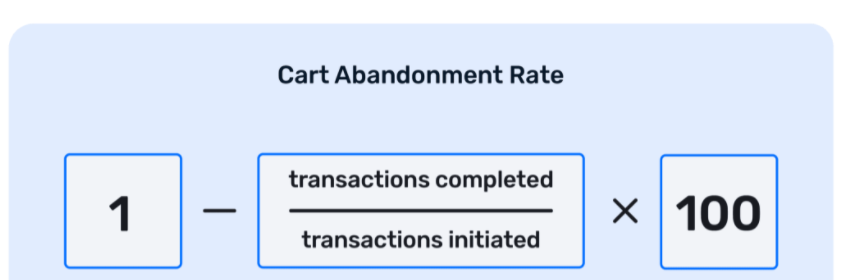
Online shopping cart abandonment is the act of a prospective customer adding items to a shopping cart but not completing the transaction. To evaluate the cart abandonment rate of your shop, you should follow this formula: 1- (total number of completed transactions/total number of carts filled) x 100.  


Before you make changes to your website, first assess the cart abandonment rate your shop is experiencing and then look for reasons and ways to improve it. 

What are the main reasons for Cart Abandonment?  

Users are complex, and cart abandonment cannot be entirely avoided. There will always be people who do not complete the transaction. However, most reasons for cart abandonment are the same for many shoppers, as they have similar buying habits and preferences. 

According to Baymard Institution, the main three reasons for cart abandonment are:
1) Extra costs are too high (shipping, tax, fees)
2) Asking to create an account for checkout
3)Delivery is too slow.


Most of these reasons have to do with a lack of research on their target market, an understanding of the user experience, and a failure to test their website’s performance or the usability of the shopping cart by users rather than just employees.  

How can you reduce cart abandonment?  

Here are the top 5 actions to reduce cart abandonment  

  1. Be transparent about all extra fees  

Be upfront with your customers about all the fees incurred, including shipping, taxes & duties. This would decrease the chances of cart abandonment and help you build trust that can later be converted into repurchases. 
Suppose your business encounters high shipping costs and unclear information on tax and duties. In that case, you should look for a cross-border solution that can provide you and your customers with a smooth shipping experience. BorderGuru is a suitable option for you, as we offer competitive shipping costs and calculate taxes & duties fees, displaying fee information clearly at checkout. This helps to be transparent and expedite delivery, as all items are custom cleared.    
 

     2. Offer different checkout options  

This is a crucial feature that can significantly impact whether a potential customer completes the transaction. Buyers do not like long checkout processes and the need to create an account to make a purchase. Asking a user to create an account before checkout can put potential buyers off and miss out on sales.  

To lower the chances of missing potential sales, offer different checkout options, for example, Member Checkout, Guest Checkout, and PayPal Checkout. This could give your business a better chance of attracting buyers to complete the transaction. The faster and easier the checkout process is for them, the lower the chances of cart abandonment. 


      3. Offer various payment options 

It is essential to be aware of and recognize the most common payment options used by your target visitors. Offering only the options, you are used to is not enough as several payment methods have become popular such as digital wallets and payment platforms such as Shop Pay and PayPal. 

The advice is to research the most commonly used payment methods by your target visitor or the countries you are selling to. For example, in Europe, paying with Apple Pay, Google Wallet, PayPal, or bank transfer is very common. Therefore, it is a matter of finding out what your visitors use for online payments and offering them to reduce cart abandonment.    


     4.  Optimize your website’s loading speed  

There’s nothing more frustrating for a user than a page taking too long to load. Site speed can often be overlooked, but it can significantly impact the user’s experience of your website. If your website takes more than two seconds to load, it increases the possibility of the shopper looking elsewhere. If your page takes four to eight seconds to load, you can lose most of your visitors. In current times, where users are used to everything being fast, they do not have the patience to wait for a website to load. 

 Three tips for speeding up your website 

  1.  Make sure your designs (images, videos, etc.) are optimized to avoid slowing down your website.
  2.  Check your site’s speed on both desktop and mobile devices. 
  3.  Establish an ongoing page load testing process to keep the loading speed minimum. 


     5- Communicate with shoppers who abandoned your website’s shopping cart  

Some shoppers need more time to decide on purchasing an item. Do not get discouraged when users abandon shopping carts. Since users are already interested in your products, it is time before they commit to buying. This means it is important to have a strategy to get their attention back to your website to get them to complete their transaction finally. 

There are two strategies to communicate with shoppers who left an uncompleted transaction: 

  • Personalized follow-up emails: This means sending them a reminder of the items they left behind and offering them a discount to get their attention and incentivize them to purchase the items. 54% of shoppers will return to the website to complete the transaction if the items left in the shopping cart have a discount. 
  • Show retargeting ads for the products left behind by shoppers. This will remind them of your products and your website. You can also run a special ad with a discount price for the item they are interested in. The aim is to attract them back to your website, increasing the chances of making a purchase.   


The most common reasons for cart abandonment are related to website and shopping cart user experience and extra costs like shipping and, taxes & duties. Brands should keep their customers’ preferences in mind to avoid these issues, it is essential to consider them when making decisions about your business and products to avoid losing potential sales. BorderGuru offers you a hassle-free international shipping service and a pleasant experience for your customers at checkout. We make international shipping as seamless as domestic shipping.


Contact Us Now to reduce your abandoned carts!